No products in the cart.

← Back to Blog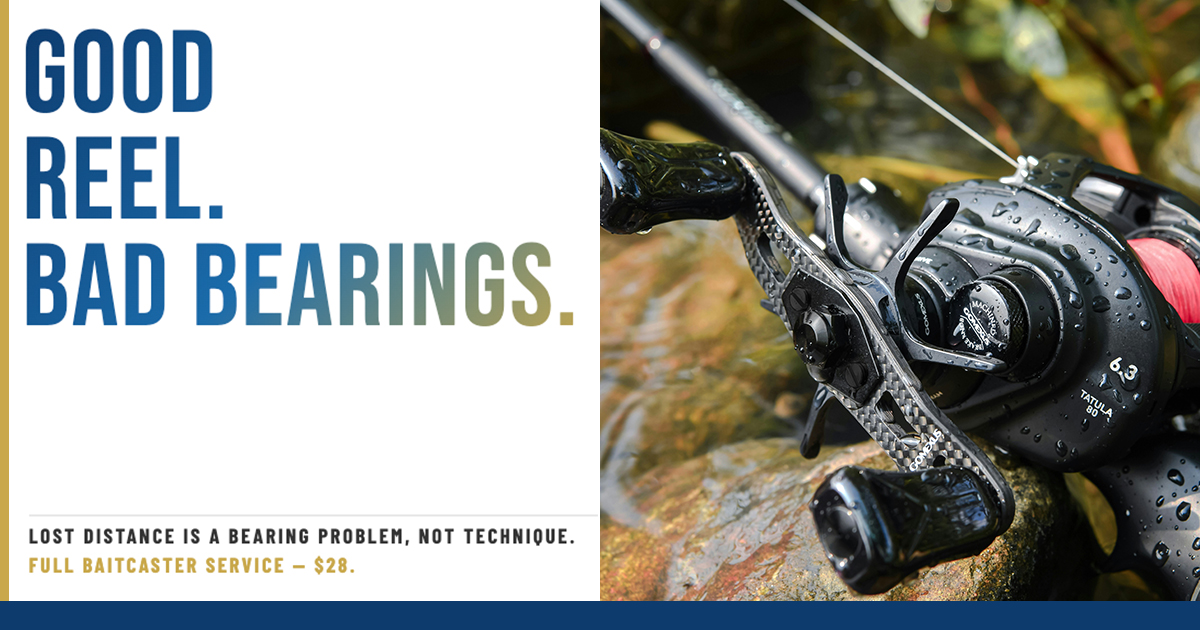
Baitcasting Reel Repair: What Breaks First, What It Costs, and When to Send It In
Baitcasting reels are the workhorses of freshwater and Gulf Coast fishing. If you're targeting redfish in Laguna Madre, throwing crank baits for largemouth, or running live bait offshore, there's a good chance a baitcaster is your go-to setup. They cast farther, handle heavier line, and give you the control that matters when a big fish runs.
But baitcasting reels are also the most mechanically complex reels anglers own. More moving parts means more ways for things to go wrong — especially in a saltwater environment. After servicing over 1,500 reels at Fischer Angling, I can tell you exactly what breaks on baitcasters, when it happens, and what it costs to fix.
If your reel has been clicking, grinding, casting short, or just feeling off, this is the guide you need. Whether you're deciding between professional fishing reel repair and a DIY fix — or just trying to understand what a service quote covers — this post breaks it all down.
How Baitcasting Reels Are Built — And Why It Matters for Repair
Baitcasting reels are mechanically different from spinning reels in one critical way: the spool rotates during the cast. That rotating spool is what makes baitcasters so precise and powerful — it's also what makes baitcasting reel repair more involved when something goes wrong.
A typical baitcaster has six to eight bearings. Most are under load during the cast. The levelwind mechanism travels back and forth across the spool, and the braking system — whether magnetic, centrifugal, or digital — has to respond in milliseconds to prevent a backlash. There's a lot happening in a very small space, and salt and grime accelerate the wear on every component.
Understanding the internal structure helps you recognize early warning signs before a minor issue becomes a major repair. The reels I see with the most damage are almost always ones that were ignored after the first symptom appeared.
What Breaks First on Baitcasting Reels
Spool Bearings
The spool bearings are the first things to go. On a Gulf Coast reel, this usually happens within one to three seasons if the reel isn't properly rinsed after every saltwater outing. Salt crystals work their way into the bearing races, displace the lubricant, and start grinding the steel balls against the housing. The early sign is a slight roughness when you spin the spool with your thumb — and a loss in casting distance.
Bearing replacement is one of the most common services we perform. Standard bearings run $6–$12 each installed. Anti-reverse bearings can be upwards of $20 each. If you want an upgrade, ceramic bearings are $24.99 each installed — they resist corrosion better and spin smoother, which translates directly to longer cast distance on every throw. All Fischer Angling ceramic bearings are ABEC 7 rated, the highest practical bearing rating for fishing reels.
Levelwind Worm Gear
The worm gear drives the levelwind back and forth across the face of the reel. It's lubricated with grease or oil, but that lubricant breaks down over time and picks up fine sand and grit from the water. When the worm gear starts to wear, you'll notice the levelwind moving unevenly, getting sticky, or stopping at certain points. Most modern worm gears are plastic while the pawl that fits into them is metal. That metal pawl can wear grooves into the gear itself — turning a routine cleaning into a parts-replacement job.
Drag System
The drag on a baitcasting reel runs on a stack of washers — most are carbon fiber or felt. These washers absorb a huge amount of stress: from big fish, long runs, and anglers who crank the star drag down tight. When drag washers wear out, you get inconsistent drag that slips under load. If you've ever been mid-fight and felt the drag "grab and release" instead of pulling smoothly, that's a worn drag stack.
Drag service is included in every routine cleaning we do at Fischer Angling. If the washers are damaged beyond service, replacement runs $15–$25 depending on the reel model. We always recommend upgrading to carbon fiber drag washers — they'll last a lifetime and are very close in price to an OEM washer.
Handle Knob Bearings
This one surprises anglers because handle knobs seem like a minor component. But handle knob bearings wear out constantly on hard-fished saltwater reels. When the bearing corrodes, the knob stops spinning freely. You end up fighting your own grip on long retrieves, which adds fatigue and throws off your feel during the fight. Handle knob bearing replacement is a small addition to any full-service job — and once you feel the difference, you won't go back.
There's also a marketing detail worth knowing: many manufacturers count handle knob bearings toward the total bearing count on the box. Most handles use two to four bearings, so a reel with three internal bearings gets marketed as a seven or nine bearing reel. It works as a selling point — and it's not entirely misleading, because handle bearings do matter — but now you know what you're looking at when you see that number.
Braking System Components
Magnetic and centrifugal brake systems don't wear out the way bearings do, but they get contaminated with salt and grit over time. Centrifugal brake magnets can wear down over multiple seasons. These housings sometimes corrode into a fixed position, making adjustment impossible. Digital braking systems — like the Shimano DC or the new Abu Garcia VoltiQ — have electronics that need to be protected from moisture intrusion, which is an entirely different failure mode.
If your braking system isn't responding the way it should — if you're getting backlashes on casts that never used to backlash — the brakes are worth inspecting during your next fishing reel repair service.
Baitcasting Reel Repair vs. Routine Service — What's the Difference?
This is a question I get regularly, and it's worth being direct about.
Routine service means full disassembly, ultrasonic cleaning, fresh lubrication, and reassembly. We inspect every component for wear, but we're not replacing parts — we're removing the contamination that causes premature wear. A routine baitcaster service runs $28 and extends the life of your reel by years. Most saltwater baitcasters need this once a season.
Baitcasting reel repair means something has already failed and parts need to be replaced. This could be bearings, drag washers, the worm gear, or internal gears. Repair costs vary by what failed and the reel model, but typically run $40–$75 for most common issues on standard to mid-range reels. High-end reels with proprietary parts can run higher — we always provide a clear quote before any work begins.
Super Tuning is a step above standard service. In addition to full cleaning and lubrication, we polish key internal surfaces, upgrade bearings, and optimize the braking and spool for maximum casting performance. If you're a tournament angler or you want your reel dialed in to cast its absolute best, Super Tuning is the option to consider.
The key distinction: if your reel is grinding, ticking, if the drag is slipping, or cast distance has dropped noticeably, you need repair — not just routine service. If the reel is running fine but has been in saltwater all spring, routine service prevents the repair. One prevents the other.
Baitcasting Reel Repair Cost Guide
Here's a straightforward breakdown of what baitcasting reel repair and service costs at Fischer Angling:
- Full Clean & Service (routine): $28
- Standard bearing replacement (each, installed): $6–$12
- Anti-reverse bearings: upwards of $20 each
- Ceramic bearing upgrade (each, installed): $12.50
- Drag washer replacement: $15–$25
- Worm gear replacement: varies by model — quoted on intake
- Super Tuning (premium service): contact for quote
One important note: these rates apply to most common baitcasting reels. If you're sending in a Shimano Calcutta Conquest, a Daiwa Ryoga, or another flagship model with proprietary parts, parts can cost more — but the service rate stays the same. We'll always tell you what you're looking at before we do the work.
When to Send Your Baitcaster In
After every saltwater season. Saltwater doesn't wait. The corrosion process starts within 24 hours of exposure if the reel isn't rinsed properly. If you've fished Galveston Bay, East Bay, Trinity Bay, or anywhere along the Gulf Coast this spring and early summer, your baitcaster needs to come in before the heat accelerates the damage further.
If you hear grinding or clicking. Don't wait on this. Grinding typically means something is broken inside your reel. Every cast you make after you first hear that sound is accelerating the wear. A $28 service now can prevent a $75–$100 bearing and gear replacement later. We go through the full list of warning signs in an earlier post — if you've noticed any of them, it's time to act.
Before a tournament. Tournament anglers need gear that performs at 100%, not 80%. A reel that's been sitting since last season — even one that sounds fine — has lubricant that's broken down and bearings starting to dry out. Pre-tournament service is one of the best investments you'll make before a major event.
If cast distance has dropped. This is a slow-developing problem that anglers often don't notice until someone points it out. If you used to reach a specific structure on a cast and you're now 10–15 feet short, that's not technique — that's bearing drag from contamination and degraded lubricant. A clean, properly lubricated reel casts measurably farther than a neglected one. How frequently this needs attention depends on your fishing patterns — we broke down the recommended service intervals in detail if you want a specific schedule for your situation.
If the drag is inconsistent. Any time your drag is doing something other than applying steady, predictable pressure, investigate it. An inconsistent drag loses fish. There's no situation where intermittent drag is acceptable, and it doesn't fix itself.
Can You Do Baitcasting Reel Repair at Home?
Some maintenance, yes. Some repair, no.
The honest answer for most baitcasters is that DIY cleaning is a maintenance habit, not a repair strategy. There are real limits to what should be attempted without the right tools and experience.
What you can do at home: rinse your reel with low-pressure fresh water after every saltwater outing. Apply a drop of Ardent Reel Butter Bearing Lube to the spool bearings. Lube the levelwind worm gear with a small amount of Reel Butter Oil or a very light grease. These habits extend the time between professional service visits significantly.
What you should not try at home: full disassembly, bearing replacement, drag washer replacement, or any repair requiring you to remove the main gear or drive train. These components require specific knowledge and experience to reassemble correctly. Most of the time when I see DIY services gone wrong, it comes down to washers installed incorrectly. Most manufacturer schematics don't even list all the washers they install on a reel — it's stated in the schematic that there could be added shims or washers not shown. And even a small shim in the wrong place can cause far more damage than the original problem you were trying to fix.
The Mail-In Process — How It Works
You don't have to be in the Houston or Galveston area to get your baitcaster serviced. Fischer Angling serves anglers nationwide through our mail-in service. We've seen reels come in from Wisconsin, Washington, Virginia, South Carolina, Oklahoma, and Oregon — just to name the most recent.
The process is straightforward: order your service online, ship your reel to us in a padded box, and we handle everything from there. We've built a proprietary system on our website that uses your address to calculate the shipping cost and sends you the label via email to print. We inspect the reel on intake, clean or repair it, and ship it back. Turnaround is 10 business days from receipt.
We service reels from across the Gulf Coast — Texas, Louisiana, Mississippi, Alabama, and Florida — and from every other state. If you're local to the Galveston or Greater Houston area, local drop-off is available as well. Contact us to arrange it. For a full walkthrough of what happens between when you ship your reel and when it comes back, we detailed our entire service process in an earlier post.
How to Protect Your Baitcaster Between Service Visits
The single best habit is rinsing after saltwater exposure. Use low-pressure fresh water — not a pressure washer, not a hose at full blast. Tilt the reel so water drains away from the interior rather than into it. Let it air dry completely before storing.
Beyond rinsing, a light application of corrosion inhibitor to the exterior adds another layer of defense between professional cleanings. We're an Ardent dealer and carry their full lineup of reel care products on our site — including Ardent Saltwater Guard Corrosion Inhibitor, which is exactly what we reach for on any reel that sees regular Gulf Coast exposure. Store reels in a dry location — never in a sealed tackle box sitting in a hot truck bed all week.
Humidity is a silent threat even when you're not actively fishing. We covered exactly how Gulf Coast humidity destroys fishing reels in an earlier post if you want the full picture. If you're running multiple reels, getting two or more in at the same time triggers our automatic multi-reel discount — no code needed.
Ready to Get Your Baitcaster Serviced?
Baitcasting reel repair doesn't have to be a mystery. The reels that come to my bench with the most damage are almost always the ones that got ignored after a warning sign appeared. The reels that last decades are the ones with a consistent service routine behind them.
If you've been fishing hard this spring and your baitcaster hasn't been in for service, now is the right time — before the summer heat accelerates what the spring saltwater started. Don't wait until you hear grinding in the middle of a cast.
Order your baitcaster service online and ship your reel in — or reach out if you have questions about what your specific reel needs. New customers save 15% with code WELCOME15 at checkout. Your reel was built to last. Let's make sure it does.
SPRING15 DEAL
LIMITED TIME OFFER
SPRING REEL SERVICE DEAL
15% OFF
ALL REEL SERVICES
USE CODE AT CHECKOUT
SPRING15
Expires April 30, 2026
- ✔ Baitcasters & spinning reels
- ✔ Gulf Coast saltwater specialists
- ✔ 10-day turnaround
- ✔ Mail-in or local drop-off
15+ years · 1,500+ reels serviced
