No products in the cart.

← Back to Blog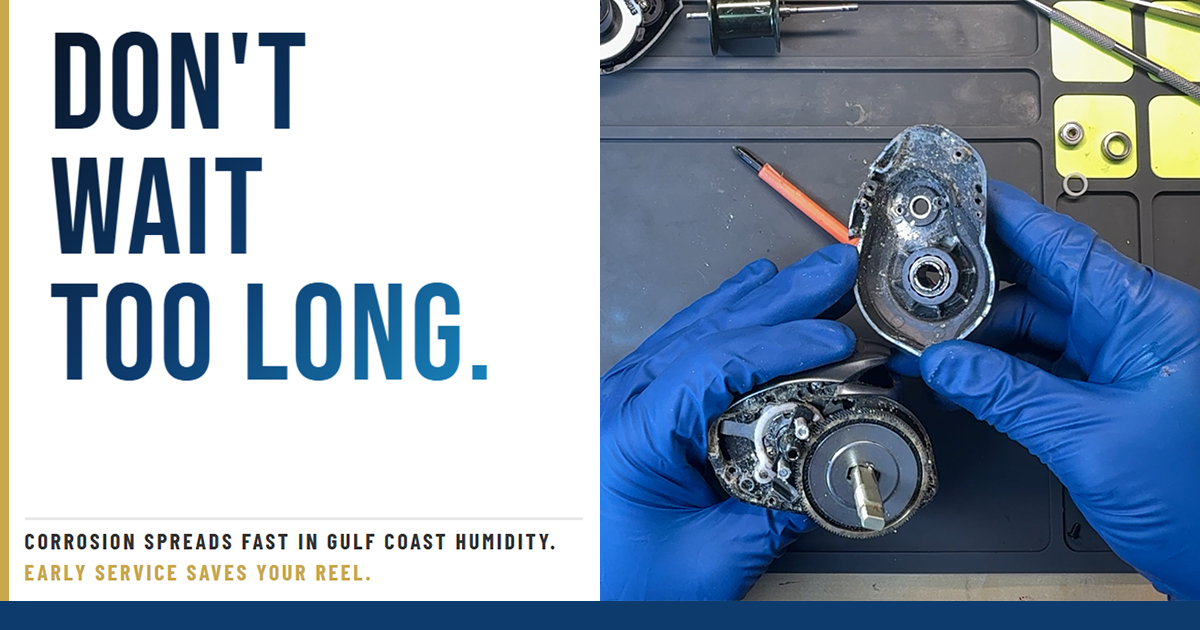
The Real Cost of Deferred Reel Maintenance
Every angler has said it. "I'll get it serviced after this season." Or after the tournament. Or when it starts slipping noticeably. I hear some version of this at least twice a week from anglers who show up at my shop with reels that have been running past their last professional service by a year, sometimes two.
What I tell them is this: deferred reel maintenance isn't free. It looks free in the short term — you skip the service and keep fishing. But the math almost always works against you by the time the bill finally comes due.
In 15 years of professional fishing reel service on the Gulf Coast, I've worked on over 1,500 reels. I can tell the moment I open a reel up whether an angler maintains their equipment or defers it. The internal components don't lie — and neither do the repair invoices.
This post breaks down exactly what deferred reel maintenance costs. Not in vague warnings, but in real numbers from a real workbench. By the time you reach the end, you'll understand why $28 twice a year is one of the smartest investments you can make in your fishing gear — and why waiting to find out is one of the most expensive habits in the sport.
The Three-Tier Cost Reality: Service vs. Repair vs. Replace
Most anglers think about reel maintenance in binary terms: the reel either works or it doesn't. The reality is a three-tier cost structure, and where you land on that spectrum is almost entirely determined by whether you maintain your equipment proactively or reactively. This also really applies to anglers who buy top-notch reels, which I categorize as any reel that costs more than around $125.
Tier 1 — Routine Professional Service: $28–$50
This is where every reel should stay. A complete strip-down, ultrasonic deep clean to eliminate corrosion, salt, and embedded grit, followed by a precision rebuild using competition-grade bearing oil and reel grease. At this stage, bearings are smooth, gear mesh is clean, and the drag stack is fresh. Problems are caught before they become failures.
For Gulf Coast anglers running their reels in saltwater, professional fishing reel service two or three times per year keeps equipment at peak performance. Some of my regular clients bring reels in annually for light recreational use; others come in every three months for heavy inshore and offshore application. Either way, the cost is predictable, low, and far less than the alternative.
Our baitcast and spinning reel service starts at $28 — that's the baseline cost of keeping a quality reel running the way it was built to run.
Tier 2 — Targeted Repair: $75–$150
This is where reels land when service has been deferred too long. At this tier, we're no longer just cleaning and lubricating — we're replacing components. Corroded bearings. Scored gears. A drag stack that's deteriorated. Main shaft and pinion gear corrosion. Each part carries an individual cost, and when you're replacing three or four components in a single service visit, the bill climbs fast.
I regularly see reels come in needing $80–$120 in replacement parts on top of the base service cost. Parts that were in perfectly serviceable condition a year earlier — before deferred maintenance let saltwater, fine grit, and degraded lubricant work through to bare metal.
Tier 3 — Full Replacement: $250–$500+
Some reels are simply past saving. When corrosion has worked through the body frame, when the main shaft is pitted beyond acceptable tolerance, when the spool is ground down from heat and stress without the protective buffer of proper lubrication — there's no economical repair path. The combined cost of parts and labor exceeds the market value of the reel itself.
That's not a worst-case scenario. It's something I see several times a year from anglers who possibly had an accident with the reel getting dunked and didn't clean it properly or just put the service off for years. Nothing with moving metal parts at high speed in a saltwater (or even freshwater) environment will.
What Saltwater Does Inside Your Reel When You Don't Service It
Gulf Coast anglers operate in one of the most corrosive environments on earth. Salt, humidity, and heat create near-ideal conditions for metal degradation — and most of that process happens out of sight, deep inside the reel body where you can't see it happening.
I covered the science in detail in our post on why coastal humidity destroys fishing reels, but here's the condensed version as it applies specifically to deferred maintenance:
The First 24 Hours After a Saltwater Trip
Salt spray and residue settle into every external crevice — levelwind channels, bail arms, spool gaps; reels aren't water tight. A thorough rinse addresses the surface exposure. But it doesn't reach the internal components, where any salt that's migrated into the reel during casting and retrieve begins its slow work.
Weeks 1–4 Without Service
Any salt that entered the reel body starts working on bearing surfaces. Bearing shields offer some protection, but they're not airtight — salt and moisture find paths in. Lubricant begins breaking down faster in the presence of contamination, losing its viscosity and protective film strength. Bearings that were buttery smooth start to feel slightly gritty. You might not notice it yet.
Months 2–6
The process accelerates. Bearing races develop micro-pitting as corrosion eats into polished surfaces. Gear teeth show early wear marks where dry or contaminated lubricant stopped protecting the metal-on-metal contact. The drag stack begins sticking slightly at the top end of its range — not enough to miss a fish, but enough that a scale would show it. A salty gritty film is left on all internal components and begins eating away at them.
One Year Without Service and Beyond
This is what shows up on my workbench. Bearings that sound like they're packed with fine gravel. Gears that feel like they're working through resistance or are seized up. Drag systems that spike and release erratically instead of applying smooth, consistent pressure. Some anglers have been fishing with this condition long enough that they've forgotten what a properly maintained reel feels like — they've calibrated down to the reel's diminished performance.
The damage is almost entirely preventable. Routine fishing reel service catches and corrects early-stage issues before chemistry and physics have time to finish the job.
The Costs That Never Show Up on an Invoice
The part of the deferred maintenance calculation that anglers most often overlook isn't the repair bill. It's everything surrounding it.
Missed Fishing Days
A reel that fails on the water doesn't schedule its failure around your convenience. It fails when you set the hook on a red drum in Venice, LA. It fails on the first morning of a multi-day wade-fishing trip down in Laguna Madre. When equipment failure costs you that fishing day — the drive, the launch fees, the fuel, the time you carved out of a packed schedule — that loss doesn't appear on any repair invoice, but it's real. A last minute reel replacement at the only tackle shop in town is a good 15% higher than what you might be able to find through a sale.
Blown Tournament Performance
I've had anglers tell me their primary tournament reel went down the morning of a competition. Equipment failure under pressure is about more than the entry fee. It's about months of preparation, tournament-day confidence, and the ability to execute when it counts. The angler running properly maintained, reliable gear has one less variable threatening a clean day on the water. It's like the confidence of running an outboard that is in perfect condition compared to one that hasn't had a service in 3 years — it's a bit scary and most of us have been there!
The Performance Tax
Even before a reel fails completely, degraded internal components cost you performance gradually. Reduced casting distance when sticky bearings add resistance to the spool. Imprecise drag performance when contaminated washers don't track smoothly under load. These aren't catastrophic failures — they're slow bleeds on your performance over time, costing you fish in ways that are easy to attribute to anything other than the real cause.
For anglers interested in maximum performance from their equipment, our Super Tuning service combines complete professional service with ceramic bearings and polished components — but none of that performance is sustainable without a baseline of routine maintenance keeping the reel clean and properly lubricated.
Why Deferred Maintenance Always Costs More
There's a pattern I see play out regularly. An angler brings in a reel with a minor early-stage issue — slight roughness in the retrieve, marginally sticky drag, a faint unfamiliar sound on the cast. The service is clean and straightforward: standard fishing reel service, maybe a single bearing swap, done in our standard window.
Six months later, the same angler brings in a different reel. Same initial symptoms when they first noticed it — but they waited. Now we're looking at replacing multiple bearings, addressing gear wear that's moved past the point of just cleaning, and rebuilding a drag stack where the washers weren't cleaned before saltwater contamination degraded them past the point of recovery.
The $28 service became $100. The component that could have been cleaned became a component that required replacement.
Understanding what actually happens during a professional reel service explains why routine service prevents this escalation — every component is inspected at each stage, and early-stage damage is addressed before the next six months of fishing accelerates it.
The trap is that deferred maintenance feels like a savings decision. You skip the service, you keep the $28, you keep fishing. What you're actually doing is trading a known, small, scheduled cost for an unknown, larger, unscheduled one. And in most cases, by the time the larger cost arrives, you've also absorbed all those performance losses in the meantime.
Running the Numbers on Reel Longevity
Let's put actual figures to this comparison, because the math makes the case better than any argument I can offer.
The Proactive Maintenance Path
Professional fishing reel service once per year for a Gulf Coast angler running moderate saltwater use: approximately $28–$56 annually, depending on reel type and service frequency. Over ten years on a quality mid-range baitcaster that cost you $300 at purchase:
- Annual service (once/year): $28 × 10 years = $280 total
- Annual service (twice/year): $56 × 10 years = $560 total
- Reel performance over that period: at or near factory spec throughout
- Expected reel lifespan with proper maintenance: 15+ years
The Reactive Maintenance Path
Skip annual service. Fish until performance noticeably degrades. Attempt repair or replace when the reel is too far gone:
- Mid-cycle repair when issues surface (typically years 2–3): $80–$150 in parts and service
- Reel replacement when repair is no longer economical: $250–$500 every 4–6 years
- 10-year cost on that same $300 reel: $900–$1,500+
- Reel performance over that period: degraded for most of it
On a premium $500 reel — the kind serious Gulf Coast tournament anglers run — the proactive service percentage drops even lower relative to the asset value, and the replacement cost swings even more dramatically against the reactive approach. The more you invest in a reel, the stronger the financial case for maintaining it professionally.
What's Actually on the Line
These numbers also don't account for something that matters to most anglers: the reel itself. Some of these reels have been fished for years. They've caught hundreds of fish. They fit a particular hand perfectly and cast the way the angler has calibrated their thumb and technique around. That's not replaceable on a shelf. Proper maintenance is how you keep fishing the equipment you've already bonded with.
Signs Your Reel Is Already Behind on Service
If you're a Gulf Coast angler who hasn't had a professional baitcaster service or spinning reel service in over a year, your equipment is likely already behind. These are the signs to watch for — any one of them warrants a look, and multiple symptoms together mean the reel is already deep into deferred territory:
- Reduced casting distance — baitcasters require noticeably more thumb control than before, or you're losing distance on identical casts
- Roughness in the retrieve — the handle doesn't spin smoothly through a full rotation; you feel slight resistance or even grinding
- Sticky or spiking drag — pressure doesn't apply or release smoothly; you feel it jumping or clicking under load rather than tracking evenly
- Unfamiliar sounds — clicking, grinding, humming, or ticking that wasn't present when the reel was newer
- External corrosion indicators — salt deposits, discoloration, or pitting around fasteners, or the body
- Levelwind hesitation — the line guide doesn't track smoothly across the spool during retrieve
Our post on the top signs your baitcaster needs professional service goes deeper on each of these if you want to do a thorough assessment of where your reel stands.
Get Your Reel Serviced Before Peak Season
Spring is one of the best fishing windows on the Texas Gulf Coast. Speckled trout are running the back bays, reds are pushing into the shallows, and flounder fishing picks back up along the transition zones. The last thing you want is to hit peak season with a reel that's been running a year past its service window — and find out what deferred maintenance actually costs at the worst possible moment.
At Fischer Angling, we offer both local drop-off at our location and mail-in service for anglers across the Gulf Coast who can't make the drive. Our standard turnaround is 10 days. We service baitcasters, spinning reels, large casting reels, dual-speed reels, and everything in between.
The math on proactive fishing reel service is clear. The performance benefit is real. The cost of waiting is higher than it looks from where you're standing right now.
Don't make the same trade I see on this workbench every week.
🎣 Spring Service Special — Save 15% With Code SPRING15
Book your spring reel service and use code SPRING15 at checkout to save 15% on any service — baitcaster, spinning reel, large casting, or dual-speed. This offer runs through April 30, 2026.
Local drop-off available upon checkout or mail-in from anywhere along the Gulf Coast or nationwide.
👉 Book Your Spring Service at FischerAnglingPro.com
Questions? Reach out here — we respond fast. More reel care guides and maintenance tips are available at our Angling Insights blog.
SPRING15 DEAL
LIMITED TIME OFFER
SPRING REEL SERVICE DEAL
15% OFF
ALL REEL SERVICES
USE CODE AT CHECKOUT
SPRING15
Expires April 30, 2026
- ✔ Baitcasters & spinning reels
- ✔ Gulf Coast saltwater specialists
- ✔ 10-day turnaround
- ✔ Mail-in or local drop-off
15+ years · 1,500+ reels serviced
