No products in the cart.

← Back to Blog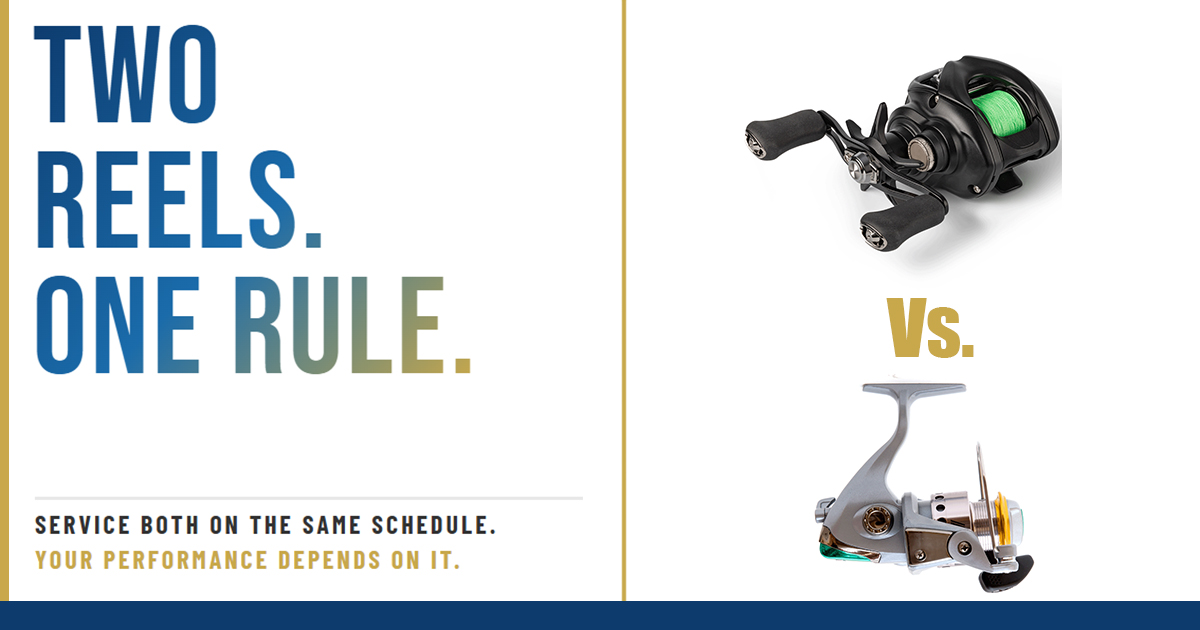
Baitcaster vs. Spinning Reel Maintenance: What Anglers Need to Know
How a Baitcaster Works — And Why It Demands More From Maintenance
If you fish the Gulf Coast — whether you're wade fishing Galveston Bay for speckled trout, throwing topwaters along Chandeleur Islands, or working the jetties for redfish — you're probably running both baitcasters and spinning reels. Most serious anglers are. Each has its place on the water, and each has its own relationship with saltwater, humidity, and hard use.
But here's where a lot of anglers get it wrong: they treat baitcaster maintenance and spinning reel maintenance as the same thing. Or worse, they treat one like it matters and the other like it doesn't. After servicing well over 1,500 reels at Fischer Angling over the past 15 years, I can tell you that both approaches cost anglers money, performance, and fish.
This post breaks down exactly how baitcaster and spinning reel maintenance differ, what the Gulf Coast environment does to each type, and how to think about service schedules for both — regardless of what you paid for the reel.
How a Baitcaster Works — And Why It Demands More From Maintenance
To understand why baitcaster maintenance is more involved, you need to understand what's happening inside the reel when you cast.
A baitcaster sits on top of the rod with its spool oriented parallel to the rod blank. When you cast, that spool spins freely at high speed — controlled only by your thumb, the magnetic or centrifugal braking system, and the spool tension knob. Line comes off the spool in a straight, direct path. That mechanical design is what gives baitcasters their casting accuracy and power, and why serious Gulf Coast and freshwater bass anglers reach for them when precision matters.
But that free-spinning spool is supported by bearings — typically two to three of them in a quality low-profile baitcaster. Those bearings are what allow smooth, high-speed rotation without friction or wobble. They're also the first components to suffer when saltwater, humidity, and grime get inside the reel. When a bearing starts to corrode or run dry, you feel it immediately — backlash becomes harder to control, casting distance drops, and the reel starts to feel rough or gritty on the retrieve.
Beyond the bearings, baitcasters have more moving parts than spinning reels: a level wind mechanism that guides line evenly across the spool, a star drag or centrifugal brake assembly, and a pinion gear engagement system. Every one of those components needs to be properly lubricated and free of corrosion to perform the way it did out of the box.
On the Gulf Coast, where you're dealing with saltwater spray, high humidity, and heat, that internal environment can go bad fast. Salt crystalizes inside the reel between trips. Humidity accelerates corrosion on exposed metal surfaces. A baitcaster that isn't regularly cleaned and lubricated starts to degrade in ways you can't see until the performance drop is significant.
Baitcaster Maintenance: What It Actually Requires
Because of that internal complexity, baitcaster maintenance is a multi-step process — and it's one where skipping steps has real consequences.
After every saltwater trip: Rinse the exterior of the reel with fresh water. Do not blast it with a high-pressure hose — that drives water inside. A gentle stream or a damp cloth is enough. This removes surface salt before it can crystalize and work its way into the frame gaps.
Every 20 to 30 hours of use, or at the start and end of each season: This is where a full professional baitcaster service comes in. A proper service involves complete disassembly, ultrasonic cleaning of all components, inspection of every bearing, drag washer replacement if needed, and rebuild using the correct lubricants for each part of the reel. Bearings get oil. Gears get grease. The drag stack gets the appropriate drag grease — not always the same product you put on the gears.
That last point matters more than most anglers realize. Using the wrong lubricant in the wrong place is a common mistake we see on reels that come into the shop. Grease on bearings kills their smoothness and can get them gummy. Oil on drag washers can dry them out, destroying drag performance. A professional service ensures every component gets exactly what it needs.
Signs your baitcaster needs service now: Increased backlash that wasn't there before, a grinding or rough feel on the retrieve, reduced casting distance, a drag that stutters instead of pulling smoothly, or any visible corrosion or salt buildup around the spool or side plates. For a deeper look at these warning signs, see our post on top signs your baitcaster needs professional service.
How a Spinning Reel Works — A Different Kind of Complexity
A spinning reel hangs beneath the rod with its spool oriented parallel to the rod — but unlike a baitcaster, that spool doesn't rotate during the cast. Instead, line peels off the front of the stationary spool as the bail arm rotates around it. When you retrieve, the rotor spins and the bail wraps line back onto the spool, which moves up and down on a drive shaft to distribute line evenly.
This design is mechanically simpler than a baitcaster in some ways — there's no free-spinning spool to manage, no braking system, no level wind. That's part of why spinning reels are easier to learn and why you can buy a functional one for next to nothing. But simpler doesn't mean maintenance-free.
Spinning reels have their own set of vulnerable components. The main gear and pinion gear drive the rotor and need proper lubrication. The bail arm and line roller — the small wheel the line passes over on retrieve — are constant friction points that attract salt and grime. The anti-reverse bearing, which prevents the handle from spinning backward, is many times the first internal component to fail on a neglected spinning reel. And the drag system, typically a front-drag stack of washers, needs to be properly greased to maintain smooth, consistent pressure.
On the Gulf Coast, the bail arm hinge and line roller take a particular beating. Salt builds up at those pivot points and causes stiffness, then corrosion. A line roller that doesn't spin freely creates line twist — one of the most frustrating problems a spinning reel angler can deal with. It's also one of the most preventable with regular spinning reel maintenance.
Spinning Reel Maintenance: Same Schedule, Different Focus
Here's the honest truth that most fishing content won't tell you: spinning reels should follow the same service schedule as baitcasters. Same rinse routine after saltwater exposure. Same professional service interval of every 20 to 30 hours of use or once per season.
The reason they often don't get that attention comes down to price perception. Many Gulf Coast anglers run inexpensive spinning reels — $30 to $80 reels that get thrown in the rod holder, dunked in the bay, and rinsed off when you remember. When something goes wrong, the calculation feels simple: just buy another one. Many of my own beginner rods that I keep on the boat for inexperienced anglers are spinning reels.
But that math changes the moment you move into mid-range or quality spinning reels. A Shimano Stradic, a Penn Battle, or even a Daiwa Exist — these are $150 to $1,000 reels that deserve the same care as any baitcaster. And even on a $50 reel, consistent maintenance dramatically extends the service life and keeps the reel performing at its best for far longer than most anglers expect.
After every saltwater trip: Same protocol as a baitcaster. Rinse gently with fresh water, paying attention to the bail arm hinge, line roller, and any areas where salt can accumulate. Let it dry before storing.
Every season or 20 to 30 hours of use: Full disassembly, cleaning, inspection of the anti-reverse bearing and drag washers, and proper lubrication throughout. The line roller bearing in particular should be checked — it's a small component that's often overlooked and commonly responsible for line twist problems.
Signs your spinning reel needs service: Line twist that keeps returning even after re-spooling, a bail that snaps closed unevenly or hesitates, a grinding feel on the retrieve, drag that jumps instead of pulling smoothly, or visible corrosion around the bail arm or rotor. Remember that spinning reels aren't watertight — they are as susceptible to water intrusion as baitcasters.
Baitcaster vs. Spinning Reel: Where the Real Difference Lies
Complexity of service. A baitcaster teardown and rebuild is a more involved process than a spinning reel service. More bearings, more precise lubrication requirements, more components to inspect and reassemble correctly. That complexity is why baitcaster service tends to cost slightly more at shops that charge by the hour — and why DIY baitcaster service has a steeper learning curve than spinning reel maintenance.
Consequences of neglect. On a baitcaster, a corroded or dry bearing shows up immediately and dramatically — backlash gets uncontrollable, casting distance drops, accuracy suffers. The reel tells you something is wrong. On a spinning reel, degradation tends to be more gradual. The retrieve gets a little rougher, drag gets a little less smooth, line twist gets a little worse. Anglers often adapt to the decline without realizing the reel is operating well below its original performance. By the time it's obvious, more damage has been done. We wrote more about the real cost of deferred reel maintenance if you want to dig into that further.
Saltwater exposure impact. Both reel types suffer in saltwater, but baitcasters have more potential entry points for salt intrusion — the level wind mechanism, the spool tensioner, the frame housing itself. A spinning reel's bail arm and line roller are highly exposed, but the internal gear cavity is somewhat better sealed on many models. Neither is immune to Gulf Coast conditions. Both need consistent attention.
Which Reel Needs Professional Service More Often?
In practice, baitcasters come through the Fischer Angling shop more frequently than spinning reels — but that's not because they need service more often. It's because anglers feel the performance drop faster on a baitcaster and take action sooner.
Both reel types need professional service on the same schedule. The difference is that a neglected baitcaster tends to demand attention more urgently and obviously, while a neglected spinning reel quietly degrades until something fails completely.
If you're running both types on the Gulf Coast or your local lake — and most serious inshore anglers are — the smart approach is to service them on the same cycle. Bring in your baitcasters and your spinning reels together at the start of spring and the end of fall. You get everything serviced at once, you protect your entire setup, and you head into peak season with every reel performing the way it should.
When to DIY and When to Call a Pro
There's a reasonable amount of spinning reel maintenance you can do at home — exterior cleaning, drag washer re-greasing, bail arm lubrication. If you're comfortable with basic mechanical work and have the right lubricants, a light cleaning and re-lube on a spinning reel is within reach for a careful angler.
Baitcaster DIY service is a different matter. The bearing arrangement, the precise lubrication requirements, and the reassembly process are all more demanding. A mistake during reassembly — a small washer left out, the wrong lubricant applied, a clip that you might have lost — shows up immediately on the water at the worst possible moment. For most anglers, professional baitcaster service is the smarter call.
For a full breakdown of what you can and can't reasonably do at home, see our post on DIY reel service.
Ready to Service Your Reels Before Peak Season?
Spring is here, and the redfish, bass, and speckled trout bite is heating up. If your baitcasters or spinning reels haven't been serviced in the past year — or ever — now is the time.
At Fischer Angling, we service both baitcasters and spinning reels at $28 per reel, with local drop-off and mail-in service available nationwide. Through April 30, use code SPRING15 for 15% off all reel services.
Don't head into the best fishing months of the year with reels that are running below their potential. Book your service today and get back on the water with confidence.
SPRING15 DEAL
LIMITED TIME OFFER
SPRING REEL SERVICE DEAL
15% OFF
ALL REEL SERVICES
USE CODE AT CHECKOUT
SPRING15
Expires April 30, 2026
- ✔ Baitcasters & spinning reels
- ✔ Gulf Coast saltwater specialists
- ✔ 10-day turnaround
- ✔ Mail-in or local drop-off
15+ years · 1,500+ reels serviced
